What makes a hair tie gentle?
A hair tie is gentle when it holds the style without gripping, rubbing or bending the same fibres too tightly. That is especially useful to consider with a wig: its hair does not replenish itself through growth, so repeated tangles or breakage can gradually change how it looks. The best choice is not necessarily the softest-looking accessory. It is one that stays in place with little tension and comes off without catching.
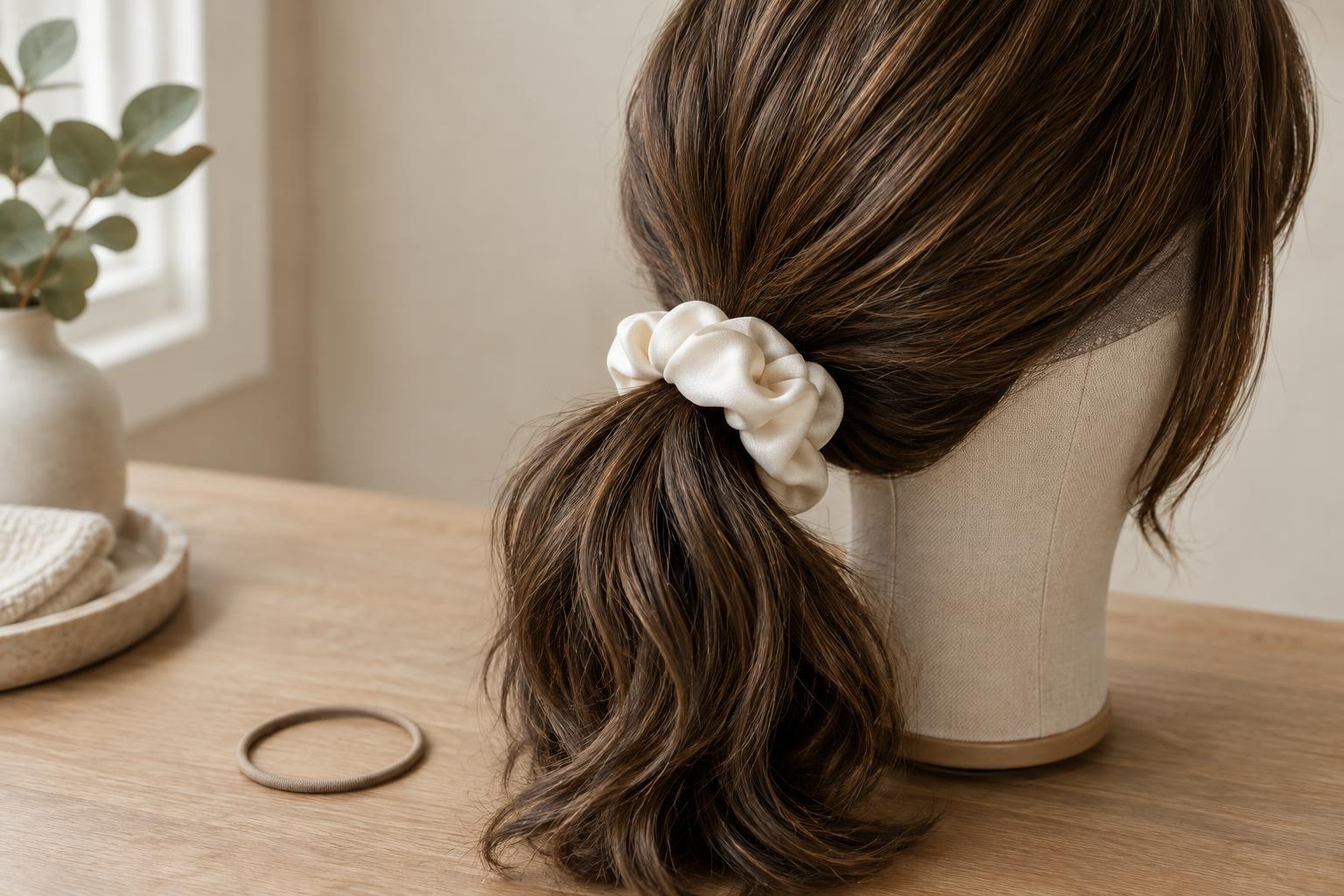
Both scrunchies and plain elastics can work, but they distribute pressure differently. A scrunchie covers its elastic core with fabric, creating a wider, softer contact area. A narrow plain elastic concentrates its grip in a smaller band. That makes a smooth scrunchie a sensible starting point for a loose ponytail or braid, while a plain elastic may be useful when a bulky scrunchie would slip. Neither should need to be wound so tightly that the hair forms a sharp bend.
Where scrunchies help—and where they do not
The fabric covering on a scrunchie can reduce direct contact between wig fibres and the stretched elastic inside. Smooth, well-finished fabrics are usually easier to slide over the hair than rough or heavily textured ones. Check the seams as well as the fabric: a loose thread, exposed join or decorative attachment can snag strands during removal.
A scrunchie is not automatically safer because it feels soft. A very tight core can still pull, and a large scrunchie may be heavy enough to drag on a loosely fitted wig. Textured fabrics can also catch fibres. Choose a size that holds with a gentle wrap or two rather than adding more turns to force a loose accessory to work.
When a plain elastic makes sense
Plain elastics take up little space, which can make them convenient at the end of a braid or beneath another accessory. If you use one, look for a smooth, fabric-covered band with no metal join, rough glue or damaged areas. A thin rubbery band that sticks to the hair is more likely to be awkward to remove, particularly from fine or easily tangled fibres.
The way an elastic is used matters as much as its design. Repeatedly tightening a narrow band in the same spot can leave a temporary kink or encourage tangles around the tie. For synthetic wigs, a tight bend may be especially noticeable because the fibres tend to retain their set style. Human-hair wigs may be restyled more readily, but their strands can still snag or break. If a style needs considerable tension to stay put, try a lower, looser position instead.
Protect the wig cap as well as the hair
Before tying a wig back, check that it fits securely without relying on the ponytail for support. Gather the hair with your hands rather than pulling hard with a brush. A low ponytail or loose braid often puts less upward or backward force on the cap than a high, tight style. This is particularly relevant around a lace front or delicate parting area, where tugging can strain the construction as well as disturb the hair.
The wig’s density and length affect what feels comfortable. A full, long wig may need a larger tie, while a lighter wig may need little grip at all. If the cap shifts, the hairline pulls or the style feels uncomfortable, loosen the tie and adjust the fit. Adding tighter wraps is unlikely to solve an underlying fit problem.
A simple routine for tying and removing
Start by detangling according to the wig maker’s care guidance, working gently from the ends upward. Gather the hair loosely and secure it without stretching the tie farther than necessary. When taking it down, hold the gathered hair near the tie and unwind each loop rather than dragging the accessory along the full length. Stop and free any caught strands instead of pulling through them.
Keep ties clean and replace them when their surfaces become rough, stretched or frayed. Avoid leaving a wig tightly tied for long periods in storage; a loose braid, hair net or appropriate stand may help it keep its shape without a concentrated pinch point. For most everyday loose styles, a smooth scrunchie offers a useful margin of gentleness. A smooth plain elastic is still an option when used lightly and removed with care.